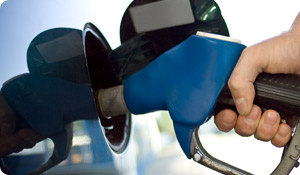
It's not news that ever-rising gas prices can be a burden on your bank account. The average family spent $4,155 filling their tanks in 2011—that's 8.4 percent of the median family's income. Numbers like these are troubling at best and many are taking measures to cut down on their expenses. Here's a few ways you can save on the commute to and from work—one of the more costly aspects of American life.
1. Public transportation.
No surprise here: Public transportation provides serious savings. If you commute to a large town or city, the chances are that buses, trains, or subways can get you there quicker and at a smaller cost. The American Public Transportation Association (APTA) estimates that a mid-size car that travels 25 miles round-trip to work will cost upwards of $2,000 dollars extra per year when compared to taking mass transit. When using public transportation to get to work, you can save even more on fares when you purchase your tickets bundled or in advance.
2. Carpooling.
Many parents carpool to save time and money when taking their children to school. Why not apply that theory to the daily grind? Carpooling helps alleviate commuter cost, traffic congestion, wear-and-tear on your vehicle, and air pollution. Some experts estimate that a person can save up to $3,000 a year. Certain websites can even help pair up potential carpoolers. Social commuting has never been easier.
3. Drive a more fuel-efficient car.
The mid-2000's saw a slip in the popularity of gas-guzzling SUVs thanks to—you guessed it—high gas prices. However, they're still popular. Drivers are just choosing a smaller, more fuel-efficient SUV model to save money. The top-selling crossover in America is the 4-cylinder Honda CR-V—and with good reason: It gets a respectable 23 mpg city/31 mpg highway. By comparison, the top-selling sedan—the four-cylinder Toyota Camera—gets 25 mpg city/35 mpg highway.
4. Telecommuting.
To reduce commuting expenses for their employees, some companies are offering four-day work-weeks or allowing staff to work from home. Telecommuting is becoming more common, especially for many Internet companies. According to the International Telework Association and Council (ITAC), 26.2 million people—nearly 20 percent of the U.S. adult working population—worked remotely at least one day a month in 2010. Ask your employer about telecommuting opportunities. Working from home just once a week could save nearly $100 a month.
5. Biking.
Although it may not be completely practical if you live 30 miles from your workplace, cycling to work can save you serious money if you're close by. Bicycle transit time is calculated at approximately 12 to 15 miles per hour. If your job is between one and 15 miles away, consider biking. You'll burn calories, not fossil fuels, on the way to the office.
6. Get better gas mileage.
If trading in your car isn't on the agenda, there are steps you can take to improve your gas mileage. By driving less aggressively, regularly changing your oil, properly inflating your tires, cutting down on speeding, and filling up with regular—not premium—gas, you can make your car more fuel efficient, and save yourself some much needed cash.
Sources:
More than 8% of Income Spent on Gas
http://money.msn.com/saving-money-tips/post.aspx?post=a923d124-e9e4-4ad3-a7be-5272c68d81bc
Press Release. WorldatWork: Despite More Frequent Use, Survey Finds First Decline in Number of Teleworkers. Web. June 23, 2011.
http://www.worldatwork.org/waw/adimLink?id=53114