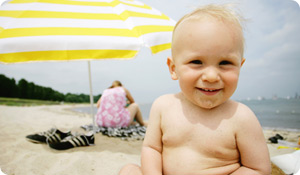
You want to take your baby outside to enjoy the fresh air and sunshine, but you also want to be sure you protect him from sunburn. Follow these guidelines, whether you're taking your child to the beach or out for a stroll in the park.
For starters, infants younger than 6 months old should not be exposed to strong, direct sunlight, according to experts. They recommend that you keep your baby indoors between 10 a.m. and 4 p.m., when the sun's rays are the strongest.
Dangerous Rays
There are several reasons why young babies and sunlight don't mix. A baby's skin is not developed enough to defend itself against the damage of ultraviolet rays. The skin's pigment cells, called melanin, don't really kick into action until six months after birth, so babies are more at risk of developing damaging sunburn than children or adults.
In addition, a baby has thinner skin until he's about a year old, which enables ultraviolet radiation to penetrate further.
What's more, because babies can't move on their own, they can't get out of the sun and into the shade if they feel sunburned. Any child who gets more than three blistered sunburns before the age of 10 has a significantly increased risk of developing melanoma, or skin cancer.
Sunscreen Safety
While it might be tempting to rely on sunscreen to protect your baby from the sun's damaging rays, experts say that sunscreens for children are not designed for use on infants under 6 months. Many contain chemicals that could be absorbed through your baby's skin or burn their tiny eyes if their hands come into contact with them.
So how can you safely enjoy the outdoors with your little one? Head out before 10 a.m. or after 4 p.m., or stay in the shade during the peak sun hours. Dress your baby in pale, lightweight, breathable clothing, such as cotton T-shirts or kimono pants, and watch for signs of overheating.
Once your baby graduates to wearing sunscreen, look for one with at least 30 SPF, but remember that sunscreen is just one piece of a complete sun-protection plan. If you're headed to the pool, your child should also wear a swimsuit with built-in sun protection and a big floppy hat. If the park is your destination, outfit your little darling in protective clothing, a hat, and sunglasses.
In all cases, avoid noontime exposure, and reapply sunscreen after swimming. If you're given the choice of spray-on sunscreen or lotion, dermatologists recommend that you opt for lotion. The spray-on versions are lighter, don't last as long, and are more likely to wear off if your child is sweating.
Remember, if you teach your baby that putting on sunscreen is something you do every day regardless of the season, just like brushing your teeth, you'll plant the seeds for a lifetime of healthy fun in the sun!